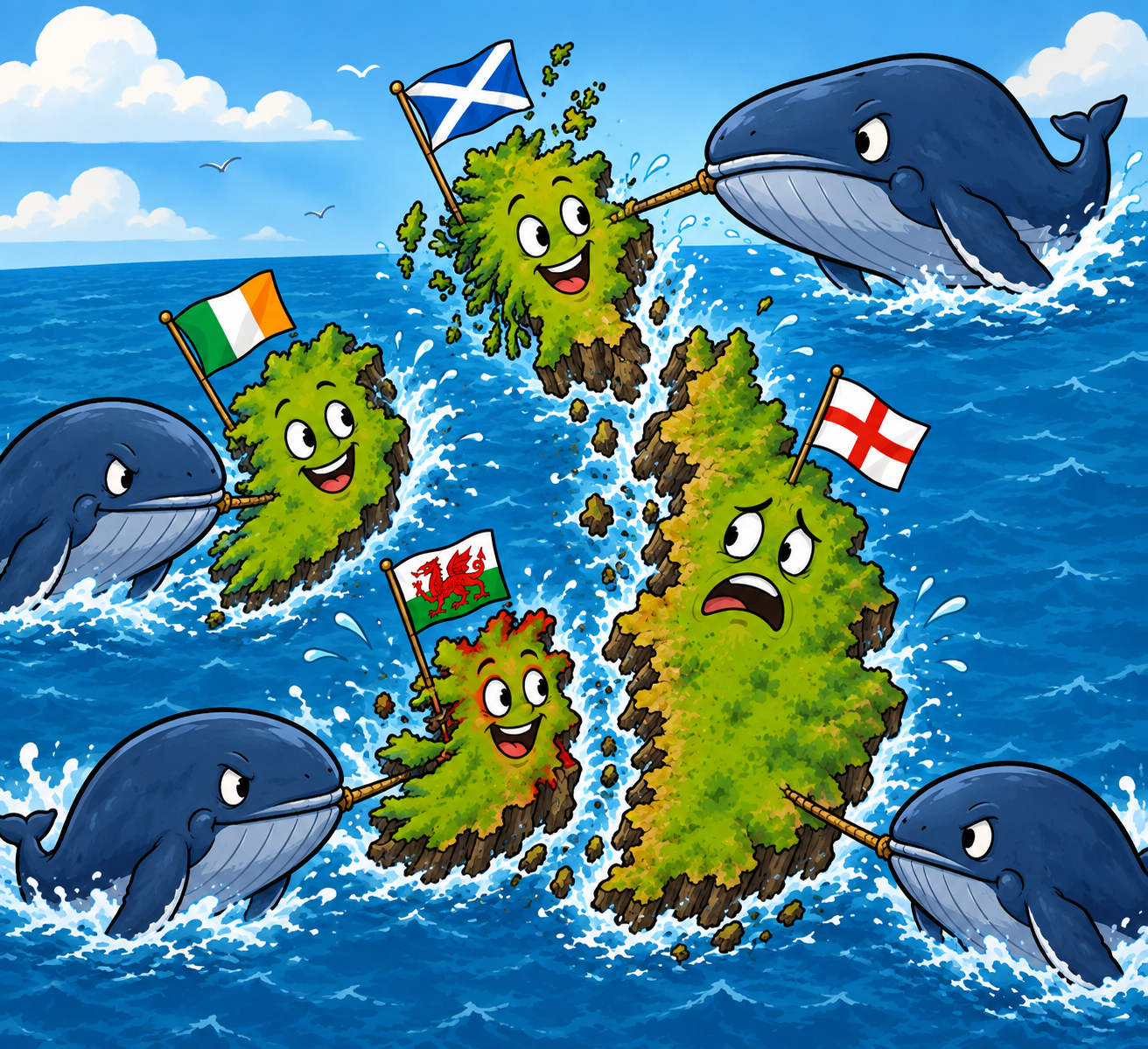
In an unprecedented display of constitutional unity, the leaders of Wales, Scotland, and Northern Ireland have signed a joint agreement asserting that no Westminster government has the right to block their nations’ democratic aspirations. The memorandum of understanding, signed on Monday, declares that “Westminster’s time is coming to an end” and affirms the principle that “our people will decide their own future.”
The signatories—John Swinney of the SNP, Michelle O’Neill of Sinn Féin, and Rhun ap Iorwerth of Plaid Cymru—represent a historic first: all three devolved nations now have first ministers who favour leaving the United Kingdom. Sinn Féin president Mary Lou McDonald also attended the meeting.
At a joint press conference, Swinney called the moment “pivotal” in the UK’s constitutional journey, invoking the “inalienable right” of self-determination. O’Neill said the “common cause” was that Westminster “does not and will never serve our people well.” McDonald described the gathering as “historic,” insisting that no prime minister can declare the right to a referendum “off the table.”
However, the leaders struck different tones on timing. While Swinney and O’Neill called for referendums, ap Iorwerth declined to set a timetable for a Welsh independence vote, noting that Plaid Cymru has ruled out a referendum before the 2030 Senedd election. He said it was “up to the people of Wales to decide their own future” and that his job was to “persuade.”
Later on Monday, the Welsh and Scottish governments signed a separate, non-legally-binding agreement to cooperate on pressing the UK government for “greater fairness” in funding and powers, as well as on issues like child poverty and EU relations. Notably, Swinney declined to back reform of the Barnett Formula—the funding system Welsh ministers have long argued disadvantages Wales—while ap Iorwerth highlighted existing Scottish flexibilities that should be extended to Wales.
The meeting drew criticism from unionist parties. Welsh Labour leader Ken Skates accused Plaid Cymru of wanting to “use power to break up Britain.” Welsh Conservative leader Darren Millar said the first minister should focus on NHS and education crises instead of independence. Reform UK’s Dan Thomas said ap Iorwerth “apparently has time to tell us what we all know—that he wants to break up the UK.”
In Northern Ireland, DUP deputy first minister Emma Little-Pengelly accused O’Neill of attempting to “weaponise the role of first minister.” The two roles hold identical powers.
The UK government responded that the prime minister “is committed to delivering change across all four nations” and “believes strongly in the union.” The devolved leaders are set to meet the prime minister next month.
The dynamics in Wales remain distinct. Ap Iorwerth, Wales’s first non-Labour first minister, has prioritised seeking additional devolved powers—such as policing and youth justice—over an immediate independence push. His government plans a national commission to “lay the foundations” for future independence plans. He also said Prime Minister Andy Burnham had “a lot to learn” about how devolution to a nation differs from devolution to a region or city of England.
Burnham recently appeared to soften his stance on a second Scottish referendum, comparing it to the conditions for a border poll in Northern Ireland, before clarifying that another vote remained “off limits.” Scotland voted to remain in the UK by 55% to 45% in 2014.